Health abroad
Pharmacy abroad: how to get the right medicine in a language you don't speak
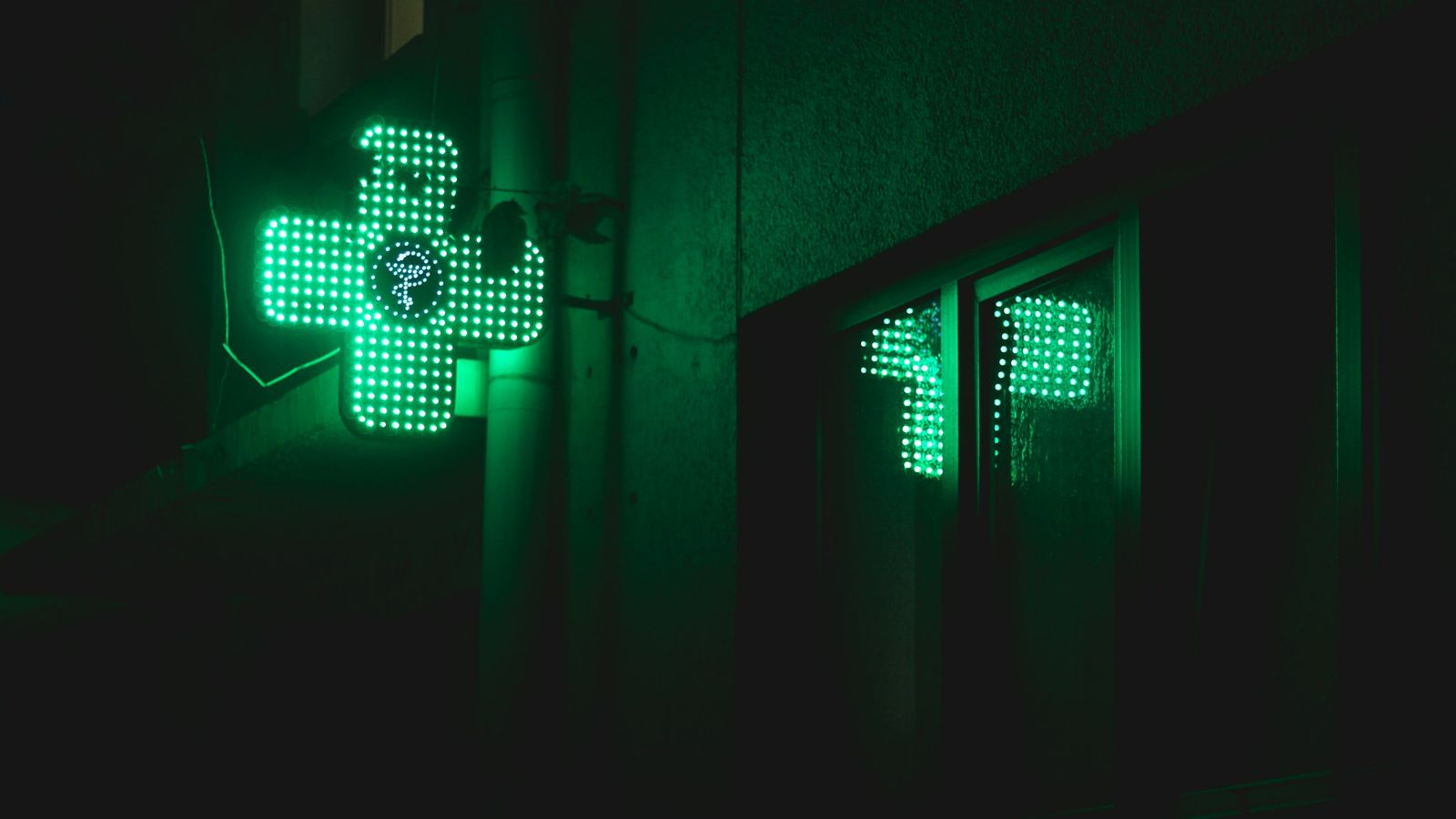
Finding a pharmacy abroad is easy: look for the green cross. The hard part is the three minutes at the counter, where five exact facts have to cross a language you do not share. Here is how to get them across.
Photo: Dima Mukhin / Unsplash
It is two in the morning in a rented apartment. Your daughter's forehead is burning, the thermometer says 39.4, and the syrup you packed ran out yesterday.
Four streets away, a green cross is still lit.
Inside, a tired pharmacist looks up. And you realise what you are about to do: describe a three-year-old's fever, her weight, the penicillin she cannot have and the medicine she had six hours ago — with your hands.
The pharmacist says something. It might be a question about her age. It might be the dose. You nod, because nodding is all you have.
Finding a pharmacy abroad is rarely the problem. Almost everywhere in Europe it is marked by the same glowing green cross, and one is always open. The problem is the conversation — short, exact, and about someone's body. This guide is about getting that conversation right, and about the rules that quietly work in a traveller's favour.
This is a guide to communication and to the rules for travellers, not medical advice. If someone is seriously ill, skip the pharmacy: call 112 anywhere in the EU, or go to an emergency department.
If you only read this
- Ask for the molecule, not the brand. Brand names change at every border. The generic name on the box does not.
- Say allergies and other medicines first. Before symptoms, before anything. It is the sentence most often lost.
- An EU prescription works in every EU country. Also in Iceland, Liechtenstein and Norway — if it is written with the generic name.
- A pharmacy is always open somewhere near you. Countries run night rotas. France: call 3237. Greece: 14944.
- The EHIC is not travel insurance. It gets you state healthcare on local terms across Europe. It does not get you home.
- The five facts
- Generic names
- Prescriptions abroad
- Night pharmacies
- Your own medicines
- What goes wrong
- The numbers
- Questions
At a pharmacy abroad, five facts have to cross the counter
A pharmacist anywhere in the world needs the same five things before handing anything over. At home you say them without noticing. Abroad, each one is a place the conversation can fail.
- Who it is for. An adult, a child, someone pregnant, someone elderly. For a child, the age and the weight — doses depend on them.
- What is wrong, and since when. "Stomach" is not a symptom; it is a region. Pain, cramps, nausea and heartburn lead to four different shelves.
- Allergies. Say them first and say them twice. This is the fact that matters most and the one most often lost in a hurried exchange.
- What else you take. Regular medicines and conditions — blood pressure, diabetes, blood thinners, asthma. They decide what is safe to add.
- What you have already taken today. And when. It is how a pharmacist avoids giving you the same ingredient twice.
None of these is difficult. All of them are precise — a number, a name, a time — and precision is exactly what pointing and miming cannot carry.
Medicine abroad has a different name: ask for the molecule
The most common failure at a pharmacy abroad is also the simplest. You ask for the brand you use at home, and the pharmacist has never heard of it — because it is not sold there under that name.
Every medicine has two names. The brand belongs to a company and changes from country to country. The generic name — officially the international non-proprietary name, or INN — belongs to the molecule, and is the same everywhere. It is printed on every box, in smaller type, under the brand.
| Same medicine | Sold as | Where |
|---|---|---|
| Paracetamol (called acetaminophen in North America) | Tylenol | United States |
| Panadol | United Kingdom and many others | |
| Doliprane | France | |
| Tachipirina | Italy | |
| Depon | Greece |
One molecule, five names, and even the generic name changes once you cross the Atlantic. So before you travel, photograph the box of everything you take — the side that shows the generic name and the strength (500 mg, 20 mg). At the counter, show the photo. A pharmacist reads "ibuprofen 400 mg" in any language.
Using a prescription abroad: what the EU guarantees
This is the rule most travellers have never heard of. Under EU law, a prescription issued by a doctor in one EU country is valid in all the others — and in Iceland, Liechtenstein and Norway too.
- Tell your doctor you will use it abroad. A cross-border prescription has to carry certain details: your name and date of birth, the prescriber's qualification, address and contact details, a signature and a date.
- It must use the generic name. The medicine is written by its international non-proprietary name, with the form, strength, quantity and dosage — precisely so a pharmacist in another country can match it.
- Valid does not mean available. The EU's own guidance is frank: a medicine may not be on sale in another country, or may have another name, and some are not authorised everywhere.
- Outside the EU, assume it does not work. A prescription from home is generally not accepted, and you will need a local doctor to write a new one. Your travel insurer's helpline can usually find you one.
Worth carrying in the EU
The European Health Insurance Card
The free EHIC gives you medically necessary, state-provided healthcare in any of the 27 EU countries, plus Iceland, Liechtenstein, Norway, Switzerland and the United Kingdom — on the same conditions and at the same cost as people insured there. That includes care for chronic or existing illnesses.
It is not a substitute for travel insurance. It does not cover private clinics, and it will not fly you home.
Finding a pharmacy abroad at night
Pharmacies keep shop hours, but illness does not. So most countries run a rota: every night, and on Sundays and holidays, a few pharmacies in each area stay open. The trick is knowing which.
- Read the door of a closed pharmacy. In most of Europe, a closed pharmacy posts the name and address of the nearest one on duty. It is the fastest method and needs no phone.
- France: call 3237. The national on-duty pharmacy line works around the clock, every day, and has a website, 3237.fr. Calls are charged by the minute.
- Greece: call 14944. It will point you to a doctor or an on-duty pharmacy — in Greek they are the εφημερεύοντα φαρμακεία, and the day's list is published online.
- Ask at the hotel desk. Night staff are asked this every week.
- If it cannot wait, do not look for a pharmacy. Call 112. It is free from any phone in all 27 EU countries, and in many of them the operator can help in English or French.
The sentence to have ready
One sentence opens the conversation. It does not carry you through the pharmacist's questions — how old, how long, what else, how much already — and those are where mistakes are made.
Travelling abroad with your own medicines
The safest pharmacy abroad is the one in your hand luggage. But medicines cross borders under rules, and some of them surprise people.
- Carry them in hand luggage, in the original packaging. With a copy of the prescription. A loose strip of tablets in a washbag is unidentifiable to a customs officer and to a foreign doctor.
- Controlled drugs need a letter. Strong painkillers, some sleeping tablets and ADHD medicines fall under this. UK guidance asks for a letter from your prescriber stating your name, your travel dates and destination, and the medicine, dose and total amount.
- Something legal at home may be banned where you are going. The UK government's warning is blunt: you could be fined or go to prison. Check with the embassy of the country you are visiting before you fly.
- Take more than you need. Enough for the trip plus a few days, split between two bags. Delays happen; replacing a prescription abroad takes a doctor's appointment.
What usually goes wrong at a pharmacy abroad
Very little of it is about medicine. Nearly all of it is about two people failing to exchange a handful of facts.
- You ask for a brand nobody there has heard of.
And repeat it louder. The name that would have worked was on the box the whole time, in small print.
- "Stomach" gets you the wrong shelf.
Without the words for cramps, heartburn or nausea, you describe a region, and the pharmacist guesses the problem.
- The allergy never gets said.
Not because you forgot — because the exchange was already hard, the pharmacist was already reaching for a box, and it felt like too much to add.
- The instructions are said once, quickly.
How many, how often, with food or without, for how many days. You catch a number. The leaflet, of course, is in the same language as the pharmacist.
- You take the same ingredient twice.
Combination cold and flu remedies often already contain paracetamol. Add the painkiller you brought from home and you have doubled the dose without knowing it. It is the reason to say what you have already taken.
- Your prescription is from outside the EU.
It is a piece of paper. You now need a local doctor, tonight, and the search for one starts from zero.
- It needed a doctor, not a pharmacist.
Pharmacists abroad are often excellent and generous with advice — and a counter conversation through a language barrier is still the wrong place to assess something serious.
Medicine abroad: the numbers
How big is the problem of getting the right medicine abroad? Bigger than most travellers assume, and better provided for than most of them know:
medical products in low- and middle-income countries is substandard or falsified, from a review of 48,000 samples in 88 countries.
World Health Organizationcountries where a prescription from an EU doctor must be recognised: the 27 EU members plus Iceland, Liechtenstein and Norway.
Your Europecountries where the European Health Insurance Card gives you state healthcare on the same terms as local residents.
European CommissionFrance's national line for the nearest on-duty pharmacy — 24 hours a day, every day of the year.
3237.frof a controlled medicine is the most a traveller can carry out of the UK without a personal export licence.
GOV.UKworks in all 27 EU countries, free, from any phone — for when a pharmacy is not the answer.
Your EuropeResearch on emergencies points the same way as the counter: studies of pre-hospital care find that a language barrier delays treatment and leads to inaccurate first assessments. A pharmacy visit is a smaller version of the same problem — a few exact facts that have to arrive intact.
Before you travel abroad: fifteen minutes that matter
- Photograph the box of every medicine you take. The side with the generic name and the strength. It is your universal prescription.
- Write down your allergies and conditions. On paper, in English and in the language of where you are going. Keep it with your passport.
- Ask your doctor for a cross-border prescription. If you are travelling within the EU and take anything regularly.
- Pack more than you need, in hand luggage. Original packaging, a copy of the prescription beside it.
- Check your destination's rules on controlled medicines. The embassy's website, before you book rather than at the border.
- Carry your EHIC and your insurance details. The card for state care in Europe; the policy number and emergency line for everything else.
- Know the numbers. 112 for emergencies in the EU. 3237 in France. 14944 in Greece.
- Install a translator you have actually tried. In a real conversation — not one you will be learning to use at a counter at two in the morning.
Pharmacy abroad: questions people ask
Can I use my prescription in another country?
Within the EU, yes: a prescription issued by a doctor in one EU country is valid in all the others, and also in Iceland, Liechtenstein and Norway. Tell your doctor you will use it abroad, so it is written as a cross-border prescription with the medicine's generic name. Outside the EU a foreign prescription is generally not accepted, and you will need to see a local doctor.
What if my medicine has a different name abroad?
It almost certainly does. Brand names change from country to country; the active ingredient does not. Ask for the generic name — the international non-proprietary name, printed on the box in smaller type under the brand. Paracetamol, for example, is sold as Tylenol in the United States, Panadol in the UK, Doliprane in France, Tachipirina in Italy and Depon in Greece.
How do I find a pharmacy abroad that is open at night?
Most countries run a rota of on-duty pharmacies, so one is always open nearby. In most of Europe a closed pharmacy posts the address of the nearest one on duty on its door. France has a national line, 3237, and Greece has 14944. Your hotel reception will usually know as well. For a real emergency anywhere in the EU, call 112.
Is it safe to buy medicine abroad?
From a licensed pharmacy in a well-regulated country, yes. The risk is elsewhere: the World Health Organization estimates that 1 in 10 medical products in low- and middle-income countries is substandard or falsified. Buy only from a pharmacy, never from a market or the street, and check that the box is sealed, in date, and has a leaflet.
Can I take my prescription medicines into another country?
Usually, but check before you fly. Keep medicines in their original packaging, in your hand luggage, with a copy of the prescription. Medicines that contain controlled drugs need a letter from your prescriber, and some countries ban substances that are ordinary at home — the UK government warns you could be fined or imprisoned. Ask the embassy of the country you are visiting.
Is a translation app enough at a pharmacy?
For explaining symptoms, allergies and what you have already taken, and for understanding how to take what you are given, it is a real help. It is not medical advice and not a certified translation. If the situation is serious, see a doctor rather than relying on a counter conversation.
Official help, in one place
- Your Europe — Presenting a prescription in another EU countryWhat a cross-border prescription must contain, and what to do if it is refused.
- European Commission — The European Health Insurance CardWhat it covers, where, and how to get one free from your national insurer.
- GOV.UK — Travelling with medicine containing controlled drugsThe letter you need, and when a personal licence is required.
- TravelHealthPro — Medicines and travelThe UK's National Travel Health Network and Centre, on carrying and buying medicines abroad.
- WHO — Substandard and falsified medical productsHow to recognise them, and why the source matters.
- Greece — National Contact Point for cross-border healthcareCross-border prescriptions as they apply in Greece.
Sources. Prescriptions and the generic-name requirement: Your Europe. EHIC: European Commission. Falsified medicines: World Health Organization. Carrying medicines: GOV.UK, TravelHealthPro. On-duty pharmacies: 3237.fr, Athens News. Language barriers in emergency care: BMC Health Services Research.
Phone numbers, charges and rules change. They were checked on 20 September 2026; the official pages linked above are the authority. This guide is general information about travel and communication. It is not medical advice.