Talking abroad
Translation earbuds, a pocket translator or a phone on the table: which one, and where
There are three ways to hold a conversation across a language: earbuds, a pocket device, or a phone on the table. Each is good somewhere and poor somewhere else. Here is which to reach for in a meeting, a taxi, at the doctor, at a dinner for five and on a noisy street.
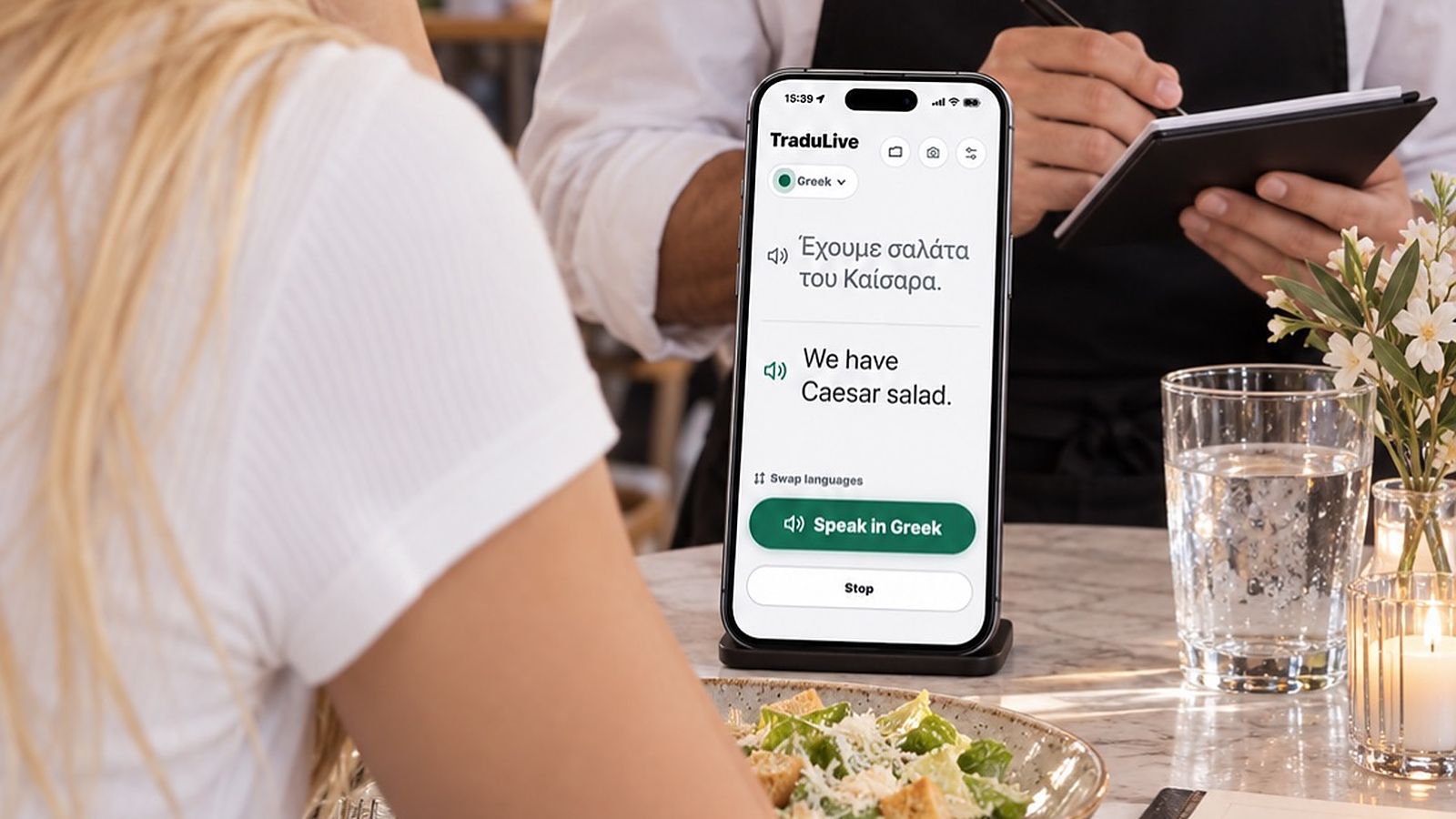
Illustration: TraduLive. A created scene, not a photograph.
The earbuds came in a small white case, and you practised with them on the flight. At the first dinner with your partner's family there are five of you round the table, and his grandmother is sitting opposite.
You hold out an earbud. She looks at it, and then at you.
She does not take it. So you keep both in, and the conversation carries on around you: four people talking at once, laughing, finishing each other's sentences. Each translation reaches your ear after the laugh is over.
There are three ways to talk across a language without an interpreter. Translation earbuds put the translation in your ear. A pocket translator is a small device you hold between you and pass back and forth. And a phone on the table listens to everyone and writes what is said on its screen, in your language.
The difference between them is rarely the quality of the translation. It is who has to wear what, who presses what, and who waits for whom — and that depends on where you are.
A word on who is writing. TraduLive is the third kind. We have tried to say plainly where the other two are better, and in some places they are. We name no brands; the categories are what matter.
If you only read this
- Earbuds are best when you are the only one listening. A walking tour, a guide, an announcement.
- A pocket translator makes you take turns. Press, speak, release, hand it over — for every sentence.
- A phone on the table asks nothing of the other person. They wear nothing and touch nothing.
- In France, a driver may not wear an earbud. Anything at the ear that can play sound is banned at the wheel.
- At the doctor, ask for an interpreter. UK guidance for health professionals says automated translation should be avoided in healthcare.
- The three ways
- Who wears what
- Taking turns
- By situation
- Where earbuds win
- What it costs
- What goes wrong
- Questions
Translation earbuds, pocket translators and a phone on the table
Translation earbuds
They speak the translation into your ear. On your own, they are a private interpreter for whatever you are listening to. For a conversation, the other person has to hear your side too: they wear one of your earbuds, or listen to your phone's speaker and talk into its microphone.
A pocket translator
A dedicated device the size of a small phone, with a microphone, a loudspeaker and a button or two. You press, speak and release; it says the translation aloud. Then it is the other person's turn. It is simple and sturdy — and every sentence is a turn.
A phone on the table
Many phone apps work like a pocket translator. What we mean here is different: the phone lies between you and listens to the whole conversation, continuously. What they say appears on the screen in your language as they say it, and your reply is spoken in theirs. You do the reading.
Who has to wear, hold and press what
This decides most conversations, and the box rarely says. The third column is the phone on the table as TraduLive does it.
| Earbuds | Pocket translator | Phone on the table | |
|---|---|---|---|
| The other person | Wears one of your earbuds, or talks to your phone | Speaks into the device, often pressing its button | Speaks normally. Wears nothing, touches nothing |
| You | Wear the earbuds, keep the phone near | Hold, press, speak, release, hand over | Read; press once to have your answer spoken |
| Turns | Sentence by sentence, after it is said | One person at a time | Nobody waits for a button |
| Three or more people | An earbud for everyone | A queue | Three or four voices, each on its own line |
| While walking | The best of the three | One exchange at a time | Poor: you have to read |
| If you cannot hear | No help | Only if it shows text | Built for reading |
Taking turns: why translators slow a conversation down
People answer each other astonishingly fast. A study of ten languages on five continents, published in PNAS, timed the answers to yes-or-no questions: in every language the most common gap was under a fifth of a second, and the average was 208 milliseconds.
Every translator breaks that rhythm, in one of four ways.
- A button makes a turn out of every sentence. Nobody can interrupt, agree halfway or ask "sorry, which street?" — the small sounds that keep a conversation on track.
- Anything spoken is heard twice. Once as it is said, and again in translation. People start speaking in short, careful sentences to cope.
- A spoken translation trails the speaker. It has to hear enough of the sentence first, so you laugh after the joke and nod after the question.
- Text can appear while they are still talking. You read along instead of waiting. The price is that your eyes are on the phone, not on their face.
Our own delay, timed from the end of a sentence to its translation on screen, is published with its method under how long you wait: a median of 0.7 seconds, with a television playing.
Earbuds, device or phone: situation by situation
A meeting
Earbuds serve the person wearing them, so everyone at the table would need a pair. A pocket translator turns the meeting into a queue for the microphone. A phone in the middle of the table grows with the room: TraduLive gives each voice its own numbered line, so you see who proposed what. Tell people at the start that the phone is listening — it is only fair, and the app asks you to. For a contract, book a professional interpreter.
A taxi
The driver's hands are on the wheel and their eyes should be on the road: no screen to read, no buttons to press.
The law in France
The driver may not wear your earbud
Article R412-6-1 of the Code de la route forbids anyone driving in traffic from wearing at the ear any device that can emit sound, hearing aids excepted. The penalty is a fine and three points off the licence.
Handing the driver an earbud is not only awkward. In France, it is against the law.
What works is whatever asks the driver for nothing: hold the phone, let them speak normally, read the answer, and let the phone say yours aloud. Agree the price before the car moves; our guide to being overcharged abroad has the official airport flat fares.
The doctor
Here the honest answer is: ask for a person. UK government guidance for health professionals says automated online translation should be avoided in healthcare, because there is no assurance of its quality, and that a professional interpreter should always be offered rather than family or friends. In the NHS, interpreting is free at the point of delivery. Wherever you are, ask at the desk whether an interpreter can be called, in person or by phone.
A translator still helps around the appointment: the reception desk, the pharmacy, where and when. In the room itself, a phone on the table at least asks the doctor to wear and press nothing.
A dinner for five
At a table of five, people talk across each other, change the subject mid-sentence and laugh at something said a moment ago. Earbuds would need one for every guest; a pocket device, a queue. A phone in the middle of the table is the only one of the three built for it. TraduLive keeps three or four voices apart, each on its own line, so you can follow four people and step in at the right moment. Be realistic: five is at the edge of that, and in a loud room, or when everyone speaks at once, the separation can slip.
A noisy street
Noise makes every method worse. Earbuds have a real advantage here: the translation plays inside your ear, where traffic has a harder time drowning it — but the other person still has to hear your side. Do not turn them up to beat the noise. The World Health Organization advises no more than 60% of maximum volume, and well-fitted, noise-cancelling earbuds so that you need not raise it.
A pocket translator hears the street as well as the person, and so does a phone. TraduLive has two settings for crowded places: one listens mainly towards the person in front of the phone, the other translates only what is loud enough to be close. For your side, a small speaker connected to the phone is optional. Or step into a doorway.
The sentence to have ready
It tells people the phone is listening, which is only fair, and it stops them slowing down and shouting. Every one of these tools is built for ordinary speech.
Where translation earbuds are simply better
- A walking tour. The guide talks, you walk, your eyes are on the city. A phone you have to read is the wrong tool.
- Listening on your own. A talk, an announcement, a museum guide. Private listening is what earbuds are for, and TraduLive does not do it: the phone listens to the table through its own microphone, and if it finds itself hearing through a headset instead, it asks you to take the headset off so that it can hear the table.
- When your hands are full. A queue, a child, bags. Nothing has to be put down.
- When you would rather not show a screen. Earbuds are discreet; a phone on the table is not.
If you are deaf or hard of hearing, it turns round: a translation spoken into your ear is still sound, and text on a screen does not depend on hearing. That is what TraduLive's hearing and speech help is for. It is not a hearing aid, and it makes nothing louder.
What translation earbuds, devices and apps cost
- Earbuds are a purchase, then a battery. Check what the translation needs — an app, an account, a connection — and whether some languages or features cost extra.
- A pocket translator is one more device to buy and charge. If it has its own data, ask how long that lasts.
- A phone on the table costs what the app costs. TraduLive gives 15 free minutes on each phone, then hours bought once — 3, 10 or 20 — with no subscription, and the minutes never expire. You can try the translation in the browser first.
- All three may need data. TraduLive needs mobile data or Wi-Fi. On a SIM from the EU or the EEA, roam like at home charges data in the EU, Iceland, Liechtenstein, Norway, Moldova and Ukraine at home prices, within fair-use limits; on a UK or other SIM, the price is your operator's. More in our guide to whether a translation app needs the internet.
What usually goes wrong with a translator abroad
Rarely the translation. Mostly the arrangement around it.
- You chose for the conversation you imagined.
One patient stranger in a quiet room. The real ones are a family dinner, a market stall and a taxi.
- You hand a stranger an earbud.
Many people would rather not, and nobody should be made to feel rude for saying no.
- The other person does not know when to talk.
With a button, they start before you have pressed it, and half a sentence goes missing.
- Everyone slows down and shouts.
Loud fragments help no translator. Ask people to talk normally.
- You rely on it where a mistake costs too much.
A diagnosis, a contract, a police statement. Ask for a professional interpreter.
Talking across a language: the numbers
the average gap before an answer in conversation, across 10 languages on five continents.
PNAS, Stivers et al.of Europeans can hold a conversation in English as a foreign language. Among young Europeans, 7 in 10.
European Commissionof maximum: the highest volume the WHO advises for earbuds and headphones.
World Health Organizationa week at an average of 80 dB: the WHO's limit for safe listening.
World Health Organizationoff a French driving licence for wearing anything at the ear that can play sound while driving.
Légifrancecountries where a SIM from the EU or the EEA pays home prices for data: the EU, Iceland, Liechtenstein, Norway, Moldova and Ukraine.
Your EuropePut the first two together and you have the whole problem: people expect an answer within a fifth of a second, and about half the people you meet in Europe will not share English with you.
Before you travel: choosing a translator in ten minutes
- List the conversations you will actually have. A tour, taxis, family dinners, a meeting. Choose for the most common.
- Count the people. With one other person, any of the three can work. With three or more, a phone on the table is the one built for it.
- Decide who will wear or hold what. If the answer is "a stranger will wear my earbud", think again.
- Check your data abroad. Unless your SIM is from the EU or the EEA and you stay inside the roam-like-at-home zone, ask your operator before you land.
- Practise at home. In a noisy kitchen, with the television on, and a charger packed.
- Know when to ask for a person. At the doctor, for a contract or a statement: a professional interpreter.
Translation earbuds or phone: questions people ask
Are translation earbuds worth it?
For listening on your own — a walking tour, a guide, an announcement — they are the most comfortable of the three: hands free, eyes free, private. For a conversation they are weaker, because the other person has to wear one of your earbuds or talk to your phone.
Do both people need translation earbuds?
The other person needs some way to hear your side. With earbuds, that usually means wearing one of yours, or listening to your phone's speaker and talking into its microphone — and many people would rather not put a stranger's earbud in their ear. With a phone on the table, they wear nothing and touch nothing.
Is a pocket translator better than a phone app?
It depends on the app. A pocket translator has buttons and a loudspeaker and spares your phone's battery, but it makes you take turns and is one more thing to charge. An app you press and pass has the same limits; one that listens continuously from the table does not.
Can I use a translator at the doctor abroad?
For the reception desk, directions and the pharmacy afterwards, it helps. For the consultation itself, ask for a professional interpreter. UK government guidance for health professionals says automated online translation should be avoided in healthcare, because its quality cannot be assured. None of these tools replaces an interpreter or a doctor.
Do translation earbuds and apps work without the internet?
Check each one before you travel. TraduLive needs mobile data or Wi-Fi; without a connection, nothing is translated. On a SIM from the EU or the EEA, roam like at home means data at home prices in the EU and a few neighbouring countries, within fair-use limits. On any other SIM, or anywhere else, ask your operator first.
Do translation earbuds help if I am hard of hearing?
Only as far as you can hear them: a translation spoken into your ear is still sound. Text on a screen does not depend on hearing. TraduLive's hearing and speech help marks every line with who said it, lets you choose the text size and speaks what you type. It is not a hearing aid and makes nothing louder.
Official pages, in one place
- Légifrance — Code de la route, Article R412-6-1The French rule on earphones for anyone driving.
- World Health Organization — Safe listeningHow loud, for how long, and what helps in noise.
- Your Europe — Mobile roaming costsWhere roam like at home applies, and its fair-use limits.
- GOV.UK — Language interpretation: migrant health guideInterpreters, family members and automated translation in healthcare.
Sources. Turn-taking: Stivers et al., PNAS, 2009. English in Europe: European Commission, Special Eurobarometer 540. Safe listening: WHO. Earphones at the wheel: Légifrance. Roaming: Your Europe. Interpreting in healthcare: GOV.UK. TraduLive's delay: measured in the app on 13 September 2026, method on the home page.
Rules, limits and figures change. They were checked on 28 September 2026; the official pages linked above are the authority. This guide is general information, not legal or medical advice.