Food abroad
Translate a menu abroad: how to order, ask and pay in a language you can't read
A menu is the one document every traveller has to read, every day, usually in a hurry. Photographing it is the easy part. Here is how to get from a page you cannot read to the plate you wanted — without the allergy, the fish priced by weight or the cover charge catching you out.
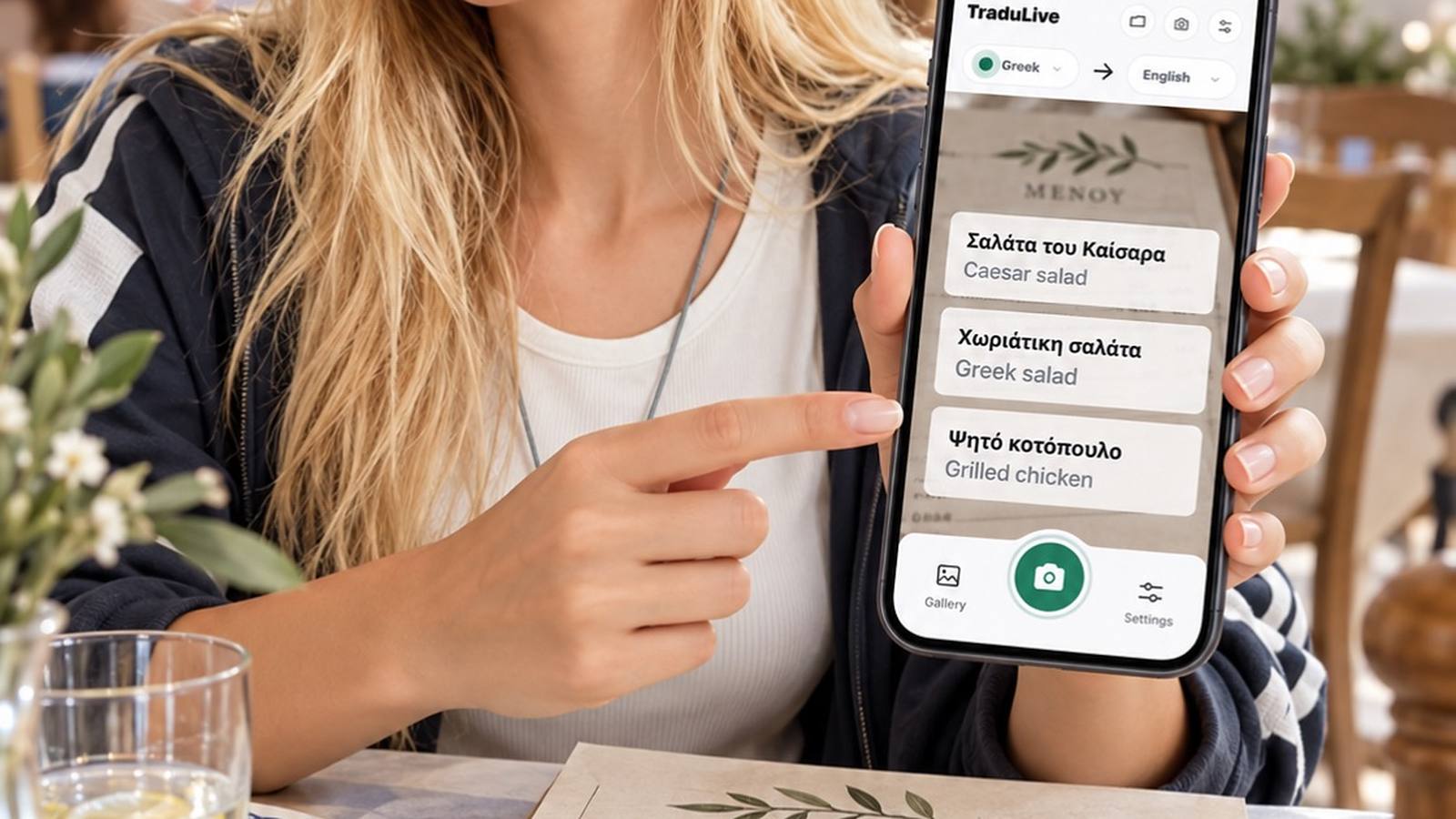
Illustration: TraduLive. A created scene, not a photograph.
It is half past eight in a harbour taverna on a Greek island. Eleven tables, a cat under one of them, and a menu printed in a single column of Greek.
You cannot even sound out the words.
By the kitchen door, a board lists more dishes in chalk. The waiter has come back for the second time, pad in hand. Your partner cannot eat sesame, and you have no idea which of these dishes contains it.
You could point at a line and hope. People do, every night. It is how they end up with a plate they did not want, a price they did not see, and an allergy nobody mentioned.
The camera on your phone has made the first step easy. What still goes wrong is everything around it: the half of the page not in the photo, the dish whose name translates into nonsense, the price that just says "market", the allergy that has to be said out loud, and the lines on the bill. This guide takes them in the order you meet them at the table.
This is a guide to communication, not medical advice. If someone has a severe allergic reaction, use their adrenaline auto-injector if they carry one, and call 112 — free, from any phone, anywhere in the EU.
If you only read this
- Photograph the whole page, flat and in good light. Prices included. The specials board gets its own photo.
- A price you cannot see is a question to ask. "Market price" or "per 100 g": ask what your portion will cost before it is cooked.
- Say the allergy before you order. In the EU and the UK, restaurants must be able to tell you which of 14 allergens a dish contains.
- A translated name is a clue, not a description. When a dish reads strangely, ask what is in it.
- The lines on the bill change at every border. Know which charges are normal where you are.
How to photograph a menu so it can be read
When a menu will not translate, the cause is usually the photo, not the language: too dark, too slanted, too small.
- Hold the phone flat above the page. Straight on. Slanted lines are harder to read than small ones, and a page photographed from your seat is usually both.
- Find the light, lose the glare. A candle-lit table is lovely and illegible. Move the menu towards a lamp or window, and tilt a laminated page until the shine is off the words.
- One whole page at a time. Prices sit in a column on the right, and they are the first thing a hurried photo cuts off.
- Photograph the board separately. The specials are often chalked up or handwritten, and handwriting is harder to read than print. Get closer.
- Keep the photo. It records what the prices were when you ordered — the evidence that settles an argument about the bill.
What should come back is each dish in your language with its original name beside it — the name the waiter knows — and the price exactly as printed. Where the menu shows no price, you should see the gap: it is a question to ask. Before you order, glance back at the paper for the price and anything to do with an allergy. A translated menu is a reading, and a reading can be wrong.
Ordering a dish in a language you don't speak
Pointing works — for the dish. It stops working when the waiter asks something back. How would you like it cooked? Chips or salad? Still or sparkling? An order is not the name of a dish. It is a short conversation that starts with one.
- Say the dish by its own name. The original name followed by "please" in their language is an order anyone in the room understands, however it is pronounced.
- Ask for changes one at a time. "Without onion." "The sauce on the side." One idea per sentence survives translation; three in one rarely do.
- Know the sizes. In Spain a tapa is a small plate, a ración a full one for sharing, a media ración half of that.
- Check what comes with it. In Italy a meat or fish main course often arrives alone; vegetables and potatoes are a contorno, ordered separately.
Food allergies abroad: what to say, and what the law says
An allergy cannot be left to a translation you have not checked. It has to be said, in words, before you order. The rules help more than most travellers know: across the EU, restaurants and cafés must provide allergen information for the food they serve. It can be given verbally, but it must be available in writing if you ask. The UK applies the same 14 allergens to restaurants and takeaways.
Worth knowing in the EU and the UK
The 14 allergens a restaurant must be able to tell you about
Cereals containing gluten, crustaceans, eggs, fish, peanuts, soybeans, milk, tree nuts, celery, mustard, sesame, sulphur dioxide and sulphites, lupin, and molluscs. If your allergy is not on the list — kiwi, say — nothing obliges anyone to know, and the question matters even more.
Outside Europe, do not assume the same. In the United States, the law on the nine major food allergens governs the labels on packaged food, not food served to order.
- Name the exact allergen. "Nuts" is not one thing: peanuts and tree nuts are separate entries on the EU list. Nor are gluten and wheat the same.
- Ask about what the menu does not say. The frying oil, the sauce, the garnish, and whether the same fryer is used. "It may contain" is an honest answer.
- Carry it written down. Anaphylaxis UK suggests translation cards that can be read out or shown to staff. A card can go to the kitchen.
- Carry the medicine to dinner. If you have been prescribed adrenaline, the NHS advises carrying two auto-injectors at all times.
The sentence to have ready
A phrase says the allergy. It does not get you through the answer — "only in the sauce", "I will ask the chef" — and the answer is what keeps someone safe.
Set menus and the dish of the day
A set menu is often the best value in the place, and the part a translation handles worst: the words are ordinary; the meaning is local.
- France: a "menu" is a set meal. Two or three courses from a short list, at a fixed price. What English calls the menu is la carte, and an entrée is the starter. The menu must say whether a drink is included: boisson comprise or non comprise.
- Spain: the menú del día. A weekday lunch at a fixed price, usually with bread, a drink and a dessert or coffee. What is included varies; ask before you assume the wine is.
- Japan: teishoku, and the ticket machine. A teishoku is a set meal with rice, soup and pickles. In ramen shops, you may buy a ticket from a machine near the entrance — the menu is the machine, and worth photographing too.
"Market price", "by weight" and the prices you can't see
The most expensive line on a menu is often the one without a number. Fish, seafood and some steaks are priced by the day's market or by weight, on a scale you have not seen.
| On the menu | Where | What it means |
|---|---|---|
| S.Q. · all'etto | Italy | Secondo quantità, by quantity; often per etto, which is 100 grams. The price per kilo is ten times the figure you see |
| Según mercado · al peso | Spain | At the day's market price, or by weight |
| Selon arrivage · au poids | France | Depending on what was delivered that day, or by weight |
| Τιμή κιλού | Greece | Price per kilo. The fish is usually chosen and weighed before it is cooked |
Ask for the price of your portion, not the rate: "how much per kilo?" has an answer that is true and useless. Ask to see the fish, and its weight, before it is cooked. A waiter can choose a smaller fish; nobody can make it smaller once it has been grilled.
Local dishes that don't translate
Some dish names are jokes, stories or family words, and a faithful translation tells you nothing about the plate:
| Dish | Word for word | What it is |
|---|---|---|
| Oyakodon Japan | "Parent-and-child bowl" | Chicken and egg cooked together in broth, over rice |
| 夫妻肺片 China, Sichuan | "Husband-and-wife lung slices" | Thin slices of beef and offal in chilli oil, served cold |
| Himmel und Erde Germany | "Heaven and earth" | Mashed potato with apple, often with black pudding |
| Andouillette France | "Sausage" | A coarse sausage made from pork intestines. Right, and incomplete |
| Toad in the hole United Kingdom | — | Sausages baked in batter. No toads |
When a translation reads strangely, it is usually a name: ask "What is in it?" When it reads normally — "sausage", "soup of the day" — it may still say nothing about what is inside, which is what matters with an allergy. And order local dishes by their local name: nobody in Osaka will recognise "parent-and-child bowl".
The lines on the bill: cover, service and tips
Not knowing the custom costs money in both directions: you pay a charge you could have refused, or tip twice for the same service.
| On the bill | Where | What it means |
|---|---|---|
| Coperto | Italy | A per-person cover charge. Normal in much of the country; it belongs on the menu, where you see it before you sit down |
| Couvert | Portugal | The bread, olives or cheese brought before you order. The price list must state that nothing, the couvert included, can be charged unless you asked for it or it has been used. Don't want it? Say so, and leave it untouched |
| Prix service compris | France | Service is already in the price, and the menu says so. A tip is a thank-you, not a debt |
| Trinkgeld | Germany | By law, listed prices must include service and every other surcharge. Rounding up is your choice |
| "Discretionary service charge" | United Kingdom | Voluntary: HMRC's guidance says customers are not obliged to pay a voluntary service charge |
| Otōshi · お通し | Japan | A small dish served with your first drink at an izakaya, charged per person and generally not optional. Tipping is not the custom |
| "Gratuity" | United States | Tipping is expected — but check whether a gratuity is already on the bill, often for larger groups, before adding another |
Point to any line you do not recognise: a legitimate charge has a name and appears on the menu. What to do about a bill that is simply wrong is in our guide to being overcharged abroad.
What usually goes wrong with a menu abroad
- The photo cuts off the prices.
You choose the dishes, and learn what they cost from the bill.
- You order the translation, not the dish.
"Sausage" sounded safe. It was andouillette.
- The specials were spoken, not written.
Recited quickly: none of them on the page you photographed, none with a price you caught.
- The allergy is mentioned after the order.
Or to the person clearing the table. It has to reach the kitchen, and it has to be said first.
- The fish is priced per 100 grams.
The number looked reasonable. It was for a tenth of the fish.
- You tip on top of service you have already paid.
Reading the bill is cheaper than guessing.
Menus abroad: the numbers
allergens that restaurants and cafés in the EU must be able to tell you about — out loud, or in writing if you ask.
European Commissionmajor food allergens in the United States, sesame the newest since 2023. The law covers packaged food, not restaurant plates.
FDAadrenaline auto-injectors: what the NHS advises carrying at all times, if you have been prescribed them.
NHSthe time from which a French restaurant must display its menus outside for lunch. For dinner, 18:00.
CCI Paris Île-de-Francefor a couvert in Portugal that you did not ask for and did not touch — and the price list has to say so.
ASAEthe day from which UK employers must pass all tips and service charges to their staff, without deductions.
GOV.UKBefore you travel abroad: ten minutes that help at the table
- Write your allergy card. The exact allergens, in English and in the local language, with "Does this dish contain…?" underneath.
- Pack the medicine in the bag that goes to dinner. Our guide to pharmacies abroad covers travelling with medicines.
- Look up how tipping works where you are going. And whether service is already in the price.
- Save 112. The emergency number everywhere in the EU, free from any phone.
- Try your translator on a real menu before you go. A takeaway leaflet will do — not for the first time in a dim taverna with the waiter waiting.
Menus abroad: questions people ask
How do I translate a menu from a photo?
Hold the phone flat above the page, in good light, and photograph one whole page at a time with the prices in the frame. A translator app that reads photos will list the dishes in your language. Check prices and anything to do with an allergy against the paper: a reading can be wrong, especially of handwriting.
How do I explain a food allergy in a restaurant abroad?
Say it before you order, name the exact allergen, and ask about the sauce, the oil and cross-contact, not just the dish. Carry it written down in the local language so it can go to the kitchen. In the EU and the UK, restaurants must be able to tell you which of 14 allergens a dish contains.
What does 'market price' or 'S.Q.' mean on a menu?
That the price depends on the day or the weight. In Italy, S.Q. means secondo quantità, by quantity, and fish is often priced per etto: 100 grams, a tenth of a kilo. Ask what your portion will cost, and ask to see it weighed, before it is cooked.
Do I have to pay the coperto or the couvert?
In Italy the coperto is a normal per-person cover charge, and it belongs on the menu. In Portugal the price list must state that nothing, the couvert included, can be charged unless you asked for it or it has been used. If you do not want the bread and olives, say so and leave them untouched.
Should I tip in a restaurant abroad?
It depends on the country. In France and Germany, listed prices already include service. In the UK a discretionary service charge is voluntary. In Japan there is no custom of tipping. In the United States tipping is expected — but check whether a gratuity is already on the bill.
Is a translation app enough to read a menu abroad?
For knowing what a dish is, what it costs and how to ask for it, it is a real help. For a serious allergy it is not enough on its own: ask in words, and wait for a clear answer. And check whether yours works offline. TraduLive does not: it needs an internet connection.
Official help, in one place
- European Commission — AllergiesThe 14 allergens, and what restaurants must tell you.
- GOV.UK — Allergen guidance for food businessesThe rules for restaurants and takeaways in the UK.
- NHS — AnaphylaxisThe signs, what to do, and carrying adrenaline.
- Portugal — ASAE, prices in restaurantsThe price list and the couvert.
- GO TOKYO — How dining out in Tokyo flowsTicket machines, otōshi and paying.
Sources. Allergens: European Commission, GOV.UK, FDA, NHS, Anaphylaxis UK. France: CCI Paris Île-de-France. Portugal: ASAE. Germany: Preisangabenverordnung, § 13. The UK: HMRC, GOV.UK. Japan: Japan National Tourism Organization, GO TOKYO. 112: Your Europe.
Rules and customs change. They were checked on 28 September 2026; the official pages linked above are the authority. This guide is general information about travel and communication. It is not medical advice.